Renovation Builders Auckland: Why Specialists Aren’t Generalists
Originally posted on Renovation Builders Auckland: Why Specialists Aren’t Generalists
Superior Renovations - Auckland’s Trusted Home Renovation Specialists
Renovation Builders in Auckland: What Sets a Specialist Apart From a New-Build Builder
Quick answer: Renovation builders work inside an existing house, with all its surprises, while new-build builders work from a flat section. The skills overlap, but the day-to-day job isn’t the same — and the wrong pick on an Auckland renovation can cost you weeks of time and tens of thousands of dollars.
Imagine you’ve signed a fixed-price quote on a $35,000 bathroom reno in your 1925 Grey Lynn villa. Day three of demolition, the builder pulls the wall off behind the shower. The framing’s spongey. There’s a slow leak that’s been seeping into the bearer below the floor for the past decade. He looks at you and says: “I haven’t done this before. I’ll need to bring in another guy. The price needs to change.”
That’s not a renovation builder. That’s a new-build builder who took a renovation job. After more than a thousand Auckland renovations, we’ve watched this play out enough times to know exactly where it goes wrong, why it goes wrong, and what kind of builder doesn’t let it happen in the first place.
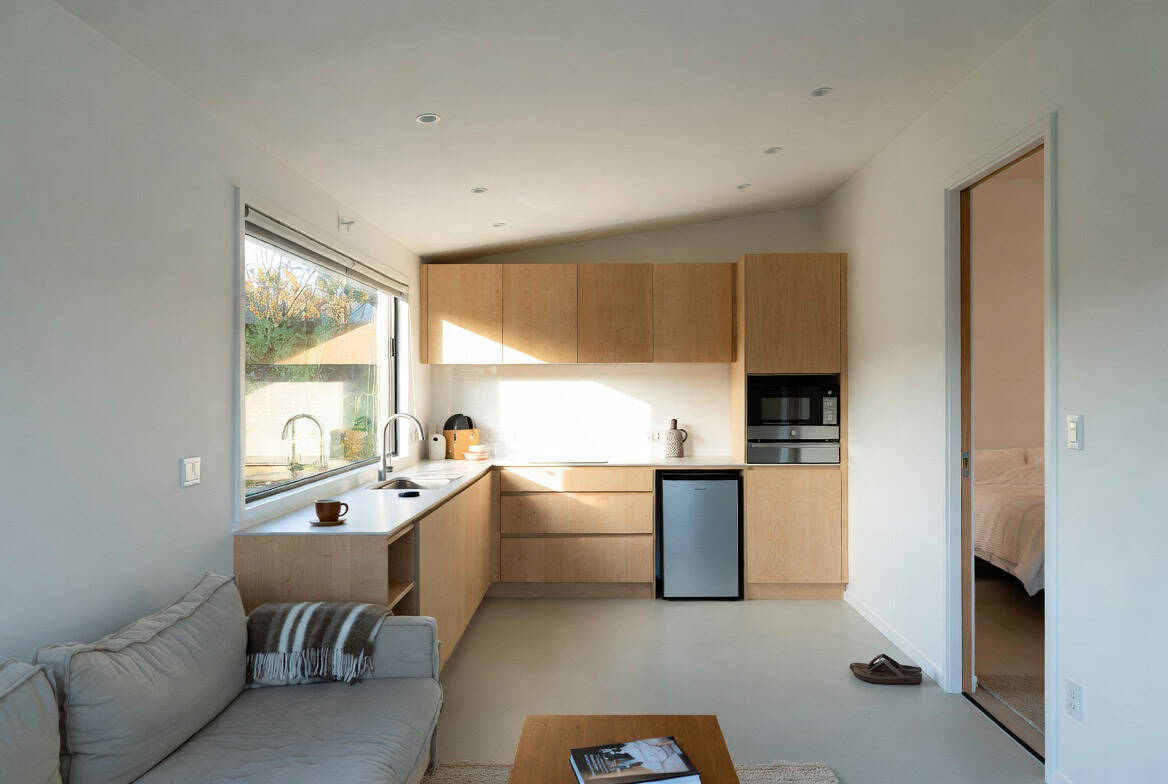
Basement Conversion
The Real Difference: New Builds Start From Zero, Renovations Don’t
A new build is a known quantity. Flat section, set of consented plans, predictable materials, predictable trades. You schedule it, you build it, you hand it over. Most things on site go the way the plans said they would.
A renovation is the opposite. You’re working inside a house that someone else built, sometimes decades ago, often using methods or materials that wouldn’t pass code today. The first time you actually see what’s behind the wall is the day demo starts. You can plan a renovation thoroughly, but you can’t make it predictable — that’s the part new-build builders find hardest.
Why the Quote Always Looks Cheaper From a New-Build Crew
This is the part that catches Auckland homeowners out. Three builders quote on the same Mt Eden bungalow kitchen. Two come in around $48,000. One comes in at $36,000. The cheap one looks like the win.
It usually isn’t. New-build crews quote off the plans because that’s how new builds work — what’s on the page is what gets built. Renovation builders quote the same job knowing there’s a 70% chance they’ll find a non-load-bearing wall that’s actually load-bearing once it comes down, an old single-skin chimney that needs bracing, or a section of subfloor that’s failed. The cheap quote isn’t cheap. It’s an opening bid.
What 1000+ Auckland Renovations Taught Us
The pattern is consistent. Generalist builders are great when the work is what the drawings show. They struggle when the work is what’s actually there. Renovation specialists carry the muscle memory for the surprises — the asbestos check before demo, the consent path for moving a load-bearing line, the protection plan for the kitchen the family’s still using, the right trade order so eight subcontractors don’t trip over each other.
Sound familiar? If you’ve already had a quote that felt suspiciously low, or you’ve been talking to a builder whose photos are all of new homes on bare sections, that’s worth paying attention to.
“The minute we open a quote conversation, the design feasibility step tells us whether someone has renovated before. They ask about the bearer beam under the kitchen. They ask whether the subfloor has been inspected. They ask what year the house was built. New-build builders don’t ask those questions because on a new build, none of it matters yet.”
— Dorothy Li, Design Manager, Superior Renovations
💡 Quick tip: Ask any builder pricing your renovation to walk you through their three most recent renovation projects — not new builds, not extensions, renovations. If they can’t name three from the past 12 months with specific suburbs and scope, they’re a new-build builder taking a reno job.
Where the Wrong Builder Costs You: Five Auckland Failure Zones
There are five places renovations consistently go off the rails when the builder doesn’t have specialist experience. Each one is a known problem in Auckland’s housing stock. None of them appear on the original quote.
1. Hidden Surprises — Asbestos, Rot, and the Pre-2000 Tax
If your house was built before 2000, there’s a real chance there’s asbestos somewhere — in the soffit linings, the textured ceiling, the vinyl floor under the lino, the eaves. WorkSafe NZ requires it to be identified before demolition and handled by licensed removalists. A specialist renovation builder schedules the asbestos check before the quote is locked. A new-build crew finds it on day two and stops the job for a fortnight.
Same story with rot. Leaky-era homes from 1994 to 2004 are scattered through Albany, Hobsonville, parts of North Shore and West Auckland — monolithic plaster cladding, often with framing damage you don’t see until it’s too late. A renovation builder budgets for the possibility. A new-build builder budgets for none of it, then charges for all of it as a variation.
2. Material Matching — When Bunnings Doesn’t Stock 1925 Weatherboard
Older Auckland homes were built in imperial sizing. Modern weatherboards, skirting, scotia, and architraves are metric. When you need to patch in 200mm of weatherboard on a villa elevation, you can’t just grab a length off the rack at Mitre 10 — you need it custom-machined to imperial dimensions to match the existing run.
Renovation builders know which timber merchants will run small-batch imperial profiles. They’ve sourced them before. They know the lead times. A new-build builder will tell you they can’t match it and suggest you replace the whole elevation — a $4,000 patch turns into a $25,000 reclad.
3. Access and Protection — The Ponsonby Driveway Problem
Inner-suburb sections are tight. A villa in Ponsonby might have a 2.8 metre driveway with a brick fence on one side and the neighbour’s hedge on the other. A new-build site has a wide-open run for the concrete truck. Renovations don’t.
That changes how you stage materials, where the skip goes, how you protect the existing floors, the timber, the bath you’re keeping. A renovation builder turns up with floor protection, building wrap, dust barriers, and a logistics plan before day one. A new-build crew turns up with the same kit they’d use on a new section and leaves you with grout on your floorboards and dust through three rooms you weren’t even renovating.
4. Consent Complexity — What Triggers Auckland Council
Not every renovation needs Auckland Council consent. Like-for-like replacement of fittings, cabinetry, finishes, and most cosmetic upgrades don’t. Move a wall, relocate plumbing, change the structural framing, or alter the external envelope, and you’re into consent territory. Heritage overlay zones — parts of Mt Eden, Ponsonby, Devonport — add another layer.
Consent processing in Auckland typically runs four to eight weeks. Council fees for residential extensions run $3,000 to $8,000. A renovation builder flags this in the feasibility stage. A new-build builder learns it the hard way after Council issues a stop-work notice.
5. Trade Coordination — Eight to Ten Trades on One Job
A standard Auckland renovation involves eight to ten different trades — demo, plumbing, electrical, gasfitting, waterproofing, tiling, cabinetry, painting, plastering, sometimes flooring and glazing. If one trade doesn’t show up on the right day, every trade behind them slides. New-build crews tend to use their own framers and finishers for most of the work. Renovation specialists are running orchestras.
This is where a lot of cheaper quotes hide. They’re priced on the assumption you’ll project-manage the trades yourself. Read the scope carefully. If you see “client to arrange plumber” or “electrical by others,” that’s a $35k renovation that’s going to take you six months and three arguments.
💡 Quick tip: A renovation should never make you the trade scheduler. If the builder isn’t arranging every trade themselves and giving you a single point of contact, the price is missing a project manager’s salary — and that absence is the difference between a 4-week bathroom and a 12-week bathroom.
The LBP Question: What Renovation Work Legally Requires a Licensed Builder
This is the bit a lot of homeowners get wrong. Not every job needs a Licensed Building Practitioner. But the moment you cross the threshold into Restricted Building Work, it’s a legal requirement — not a recommendation.

Superior Renovations
Restricted Building Work — The Legal Threshold
Per MBIE’s Building Performance, Restricted Building Work covers the parts of a home that are critical to weathertightness and structure. In practical terms, an LBP is required for:
- Removing or modifying load-bearing walls, beams, or columns
- Adding or removing floors, ceilings, or staircases that affect structure
- Modifying foundations, piles, or subfloor framing
- Extensions and second-storey additions
- Recladding, including changing cladding material
- Roofing work that affects structure or weathertightness
- Installing or relocating fire-rated walls or ceilings
- Seismic strengthening
What Doesn’t Need an LBP (And Why Some Builders Won’t Tell You)
Painting, simple plumbing, basic electrical replacements, like-for-like kitchen and bathroom fittings, internal cabinetry — none of this requires an LBP. We mention this because a lot of homeowners get talked into paying premium rates for jobs that aren’t restricted. The LBP requirement protects you on the parts of your house that hold the rest of it up. It doesn’t apply to the parts that don’t.
How We Handle Consent Work — The Sonder Architecture Bridge
When a renovation crosses into Restricted Building Work or needs a building consent, we work alongside Sonder Architecture — they sit in the same Wairau Valley showroom we do, which makes the architectural drawings and engineering documentation process much shorter than handing it off to a separate firm across town. The handover process: enquiry comes in, we run the feasibility, Sonder does the architectural drawings if consent is needed, we cost the build off the consented plans, you sign once, and we manage the council communication through to Code Compliance Certificate.
💡 Quick tip: Before signing a renovation contract, check the builder’s LBP licence at lbp.govt.nz. It’s free, takes 30 seconds, and tells you whether they’re licensed for the specific category of work your renovation involves (Carpentry, Site, Design, Bricklaying/Blocklaying, External Plastering, Roofing, Foundations).
Credentials That Matter — And the Ones That Don’t Mean What You Think
There are three credential systems flying around the Auckland building industry, and homeowners often assume they’re interchangeable. They’re not.
Registered Master Builders vs NZ Certified Builders
Both are legitimate industry associations and both have credibility. Registered Master Builders is the older, larger body, with a 10-year Master Build Guarantee available on new builds and major renovations. NZ Certified Builders is a trade-qualification-led body — every member has a trade qualification, which isn’t a requirement for Master Builders.
Here’s the part most homeowners don’t know: neither badge guarantees the builder has done a single renovation. Both schemes admit builders whose entire portfolio is new builds. Ask to see specifically renovation-focused projects, not just the badge on the website.
What an LBP Licence Actually Proves
The LBP scheme is a government licensing system — not an industry association. Holding an LBP licence means a builder has been assessed against the Building Code as competent to carry out specific categories of Restricted Building Work. It’s the legal minimum for structural and weathertightness work on most Auckland renovations.
It does not, on its own, mean someone is good at renovations. It means they’re licensed to legally do certain work. That distinction matters.
“Master Builder isn’t a renovation badge. It says someone is qualified to build a house. It doesn’t say they know what to do when you pull the weatherboard off your Herne Bay villa and find the framing’s rotten. Those are different jobs entirely, and the credential won’t tell them apart for you.”
— Cici Zou, NZ Dip. Interior Design, Certified Designer, Superior Renovations
The Insurance Baseline — $5m PL and $1m PI Minimum
Any company renovating your home should hold Public Liability Insurance of at least $5 million and Professional Indemnity Insurance of at least $1 million. This protects you against property damage, injury, and design/specification errors during the build. Always ask for a current certificate of currency before you sign — not a screenshot from two years ago. We’re happy to send ours through on request, and any legitimate renovation builder will do the same.
💡 Quick tip: When you ask for proof of insurance, ask for the current Certificate of Currency from their broker — that’s the document that confirms the policy is active right now. A copy of a policy schedule from 18 months ago doesn’t tell you whether they paid the premium last month.
The Seven Questions That Filter Out the Wrong Builder Fast
Ask every renovation builder you’re considering these seven questions. The answers separate specialists from generalists in about 15 minutes.
1. “Can you show me three Auckland renovations you’ve completed in the past 12 months, with suburbs and scope?”
A specialist names them immediately. A new-build builder hesitates or pivots to new-build projects.
2. “Who organises the asbestos check, and at what stage?”
The right answer: before the quote is finalised, by a licensed assessor, with the cost factored in. Any other answer means you’re carrying the asbestos risk yourself.
3. “What’s your fixed-price scope, and what counts as a variation?”
A serious renovation builder gives you a written scope with named exclusions. Vague answers are how $35,000 bathrooms become $50,000 bathrooms.
4. “How many trades will you coordinate, and who’s my single point of contact?”
Eight to ten trades on a full renovation is normal. There should be one project manager named on the contract, not “we’ll let you know.”
5. “Can I see your LBP licence number and current Certificate of Currency for both PL and PI insurance?”
If they can’t produce both within a day, walk.
6. “What’s your approach when something unexpected comes up behind the wall?”
You want to hear about a documented variation process — written notice, costed quote, your sign-off before extra work begins. Not “we just keep going and sort it out at the end.”
7. “Will you handle the consent application, or do I need to engage an architect separately?”
For any structural or extension work, full-service renovation builders manage the consent process end-to-end. If they’re sending you off to find your own architect, you’re managing the project, not them.
💡 Quick tip: Run these seven questions over the phone before booking site visits. You’ll save yourself three or four wasted meetings. The builders worth meeting will answer in detail without needing to call you back.
Can a Renovation Builder Do a New Build? Mostly Yes — With One Caveat
The reverse question matters too. We do new builds occasionally, and most experienced renovation builders can. The problem-solving habits transfer well: detail orientation, weathertightness obsession, trade coordination, working to a fixed price under real conditions.
Where they don’t transfer is volume work. A new-build production builder turning out 80 homes a year on a Hobsonville subdivision has systems, supply contracts, and crews optimised for repetition. A renovation specialist isn’t priced for that game and shouldn’t pretend to be. If you’re building one architectural home on a one-off section, a renovation builder can absolutely do it. If you’re building five identical townhouses, hire a volume builder.
What Happens Next
If you’re at the stage of choosing a renovation builder for an Auckland home, the seven questions above will narrow your shortlist quickly. From there, the next step is a free in-home consultation — that’s where the design feasibility, scope, and fixed-price quote come together. We do these across all of Auckland — North Shore, Central, West, East, South — and there’s no obligation to engage us after.
If you’d rather start with rough costs first to check the project’s feasible against your budget, our renovation cost calculators cover bathrooms, kitchens, extensions, recladding, and full home renovations.
➡ Book your free in-home consultation with Superior Renovations
➡ See our full Auckland home renovation service
➡ Request a free feasibility report for your project
Do all builders in Auckland do renovations?
No. Most builders are new-build specialists — they build houses on bare sections from consented plans. Renovation builders work inside existing homes and deal with unknowns behind the walls. Both hold LBP licences, both can be Master Builders or NZ Certified Builders, but the day-to-day work and the skills required are different. Always ask any builder to show you their last three renovation projects with suburbs and scope before signing.
Do I need a Licensed Building Practitioner (LBP) for a renovation?
Only for Restricted Building Work — load-bearing wall changes, foundation work, recladding, extensions, second-storey additions, structural roofing work, fire-rated wall installation, and seismic strengthening. Cosmetic work like painting, like-for-like cabinetry replacement, and basic plumbing/electrical does not legally require an LBP. Check the full list at building.govt.nz. You can verify any builder's LBP licence at lbp.govt.nz for free.
How much should an Auckland renovation cost in 2026?
As of 2026, a mid-range bathroom renovation runs $25,000–$35,000 and a mid-range kitchen runs $28,000–$35,000, both including design, all trades, and project management. A full house renovation starts from around $140,000 for a single-level home and $180,000 for a two-storey, with the average spend across the kitchen, bathrooms, flooring and painting falling between $80,000 and $160,000. House extensions start from $80,000 for a ground floor extension and $150,000 for a second-storey addition.
What's the difference between a Master Builder and an NZ Certified Builder?
Both are legitimate industry associations. Registered Master Builders is the larger, older body and offers the Master Build Guarantee on major work. NZ Certified Builders requires every member to hold a formal trade qualification, which is not a requirement to join Master Builders. Neither badge confirms the builder has any specific renovation experience — both schemes include builders whose portfolio is entirely new builds. Always ask for renovation-specific project references.
How long does an Auckland renovation take?
A standard bathroom renovation takes 3–4 weeks from demolition. A standard kitchen renovation takes 5–6 weeks, or 6–12 weeks if structural changes are involved. A full house renovation (two bathrooms, kitchen, flooring, painting on a three-bedroom home) usually takes 12–16 weeks. If Auckland Council consent is needed, add 4–8 weeks for processing before site work can begin. Splashbacks add a separate installation visit after the main build.
What insurance should a renovation builder have?
At minimum, Public Liability Insurance of $5 million and Professional Indemnity Insurance of $1 million. PL covers property damage and injury during the build; PI covers design and specification errors. Ask for a current Certificate of Currency from their insurance broker — not a screenshot or a copy from 12 months ago. A legitimate Auckland renovation builder will produce this within a day of your request.
Do I need consent for my Auckland renovation?
Like-for-like replacement of fittings, cabinetry, finishes, and most cosmetic work does not need Auckland Council consent. Consent is required for: removing load-bearing walls, moving plumbing to a new location, changing the external envelope or cladding, structural roofing changes, extensions, and most work in heritage overlay zones (parts of Mt Eden, Ponsonby, Devonport, Parnell, Remuera). Council processing takes 4–8 weeks; fees for residential extensions run $3,000–$8,000.
Can a new-build builder still do my renovation?
Technically yes — both jobs use overlapping skills and the same legal licensing. In practice, new-build builders frequently underquote renovations because they price off the plans without budgeting for the unknowns renovation specialists expect (asbestos, rot, non-matching materials, single-skin construction, framing surprises). The result is variations stacking up during the build. If a quote is significantly lower than others on the same scope, ask specifically what's been allowed for behind the walls.
What questions should I ask before hiring a renovation builder?
Seven questions cover most of the risk: (1) Show me three Auckland renovations from the past 12 months with suburb and scope. (2) Who organises the asbestos check, and when? (3) What's your fixed-price scope and what counts as a variation? (4) How many trades will you coordinate, and who's my single point of contact? (5) Can I see your LBP licence and current insurance Certificates of Currency? (6) What's your variation process when something unexpected appears? (7) Do you handle consent applications in-house, or do I need a separate architect?
Why is the cheapest renovation quote often the most expensive in the end?
Because new-build builders quote off what's on paper, while renovation specialists quote with an allowance for what's likely behind the walls. The cheap quote isn't dishonest — it's just incomplete. Once demo starts and the unknowns appear (rotten subfloor, asbestos linings, non-matching weatherboards, undersized framing), every one becomes a variation. The final cost frequently lands above what the more expensive quote would have been, with weeks of delay added. Fixed-price contracts from experienced renovation builders are the protection against this.
What areas of Auckland do Superior Renovations cover?
All of Auckland. Central Auckland (Ponsonby, Grey Lynn, Mt Eden, Epsom, Remuera, Newmarket, Parnell, Herne Bay, St Heliers), North Shore (Takapuna, Devonport, Albany, Glenfield, Milford, Birkenhead, Browns Bay), East Auckland (Howick, Pakuranga, Botany Downs, Flat Bush, Bucklands Beach), West Auckland (Henderson, Te Atatu, New Lynn, Glen Eden, Titirangi), and South Auckland (Manukau, Papatoetoe, Mangere, Papakura, Takanini, Pukekohe). Our showroom is at 16B Link Drive, Wairau Valley.
Further Resources for choosing your Auckland renovation builder
- Featured projects and Client stories to see specifications on some of the projects.
- Real client stories from Auckland homeowners
- 20-point checklist for selecting the right renovation company
- Quick checklist for choosing a builder on the North Shore
- How to choose an architect for your renovation
Need more information?
Take advantage of our FREE Complete Home Renovation Guide (48 pages), whether you’re already renovating or in the process of deciding to renovate, it’s not an easy process, this guide which includes a free 100+ point check list – will help you avoid costly mistakes.
Download Free Renovation Guide (PDF)
Still have questions unanswered?
Book a no-obligation consultation with the team at Superior Renovations, we’d love to meet you to discuss your renovation ideas!
[contact-form-7]
Or call us on 0800 199 888

Have you been putting off getting renovations done?
We have partnered with Q Mastercard ® to provide you an 18 Month Interest-Free Payment Option, you can enjoy your new home now and stress less.
Learn More about Interest-Free Payment Options*
*Lending criteria, fees, terms and conditions apply. Mastercard is a registered trademark and the circles design is a trademark of Mastercard International Incorporated.
The post Renovation Builders Auckland: Why Specialists Aren’t Generalists appeared first on Superior Renovations. #superiorrenovations


Comments
Post a Comment