Kitchen Layout Guide NZ: 6 Layouts & the Work Triangle
Originally posted on Kitchen Layout Guide NZ: 6 Layouts & the Work Triangle
Superior Renovations - Auckland’s Trusted Home Renovation Specialists
Quick answer: The best kitchen layout is the one that keeps your sink, stove and fridge close enough to move between easily — the “work triangle” — while leaving clear walkways and enough bench space for how your household actually cooks. For most Auckland homes that’s an L-shaped or galley layout in tighter spaces, and a U-shaped or island layout where there’s room to spread out.
Planning a kitchen layout is the part of a renovation that quietly decides everything else. Get it right and the room works for fifteen years without you thinking about it. Get it wrong and you spend every dinner walking around an island that’s 200mm too close to the oven. Whether you’re reworking a tight galley in a Ponsonby villa or opening up a family kitchen in Albany, the layout is the foundation — so this guide covers the six main kitchen layouts, the work triangle, the measurements that matter, and the design moves our team uses to make Auckland kitchens flow.
What Is the Best Kitchen Layout? The Six Main Types
There’s no single best kitchen layout — there’s the right one for your space and how you cook. The six layouts below cover almost every Auckland kitchen, from a single-wall apartment to a double-island entertainer.
- Galley — two parallel runs of cabinetry with a walkway between. Best for narrow rooms and one main cook.
- L-shaped — cabinetry along two adjoining walls. The most versatile layout; suits small-to-medium kitchens and open-plan corners.
- U-shaped — cabinetry on three walls. Maximum bench and storage; needs a larger room.
- Island — a freestanding bench in the centre, added to an L, U or open-plan layout for prep, storage and seating.
- Peninsula — an island connected at one end, giving the same benefit where there isn’t room for a standalone island.
- Single-wall — everything on one wall. The footprint-saver for apartments and very small spaces.
At the centre of all six is the work triangle: the path between your sink, stove and fridge. Keep the three legs adding up to roughly 4–8 metres with no through-traffic crossing the middle, and the kitchen will feel efficient no matter which layout you choose. Everything else — storage, lighting, finishes — is built on top of getting that triangle right.
Kitchen Ergonomics and the Work Triangle
Ergonomics is the study of designing a space around the people using it, rather than making people adapt to the space. In a kitchen, that mostly comes down to the work triangle — and it’s the single most useful planning idea we give clients.
The work triangle connects the three spots where the actual work happens: the stove (cooking), the sink (cleaning and prep), and the fridge (storage). The rule is simple. Those three points should sit close enough to move between in a few steps, and nothing — no island, no dining table, no walkway — should cut through the middle of the triangle.
“The work triangle is old, but it still holds. What’s changed is that modern open-plan kitchens run on zones as much as the triangle — a prep zone, a cooking zone, a cleaning zone, a storage zone. In a busy Auckland family kitchen with two people cooking, zoning is what stops everyone colliding at the same bench.”
— Dorothy Li, Design Manager, Superior Renovations
💡 Quick tip: if two people cook in your house regularly, plan for it. Allow 90–120cm of walkway so two people can pass, and give the second cook their own bit of bench away from the main triangle.
7 Essentials to Plan Before You Choose a Kitchen Layout
Whatever shape your kitchen ends up, it has to be livable first. You need to move around it without bumping into things, and open every cabinet and appliance door without it hitting something else. That’s why space planning comes before shape. Here are the seven things our designers work through before locking in any layout.
1. Foot Traffic and Designated Storage Zones
Your first job is a clear primary pathway through the kitchen that doesn’t get blocked when the oven or dishwasher door is open. Kitchens are high-traffic — usually the busiest room in the house. Map where everything lives before you design: big appliances, cutlery, everyday utensils, the washing zone, the cooking zone. Give each a designated home. The drawing below shows how the zones should fall.

Clear zones for circulation, meal prep and cooking (Image courtesy RoomSketcher)
2. Distance Between Your Fixtures
A cramped kitchen looks fine on a plan and fails in real life. Think about the gap between your cooking zone and your sink, and don’t let the fridge sit so far from the stove that you’re walking laps mid-cook. Your dishwasher wants to be right by the sink so you can rinse and load in one move. The plan can hide these problems; the daily cooking won’t.
3. Distance Between Your Island and the Cooking Area
If you’ve got an island, the gap between it and the cooktop matters more than almost anything else. Too far and your prep-to-cook flow falls apart. Too close and only one person can work in the space, and the island’s own cabinet doors start colliding with the run behind them. Aim for 100–120cm of clearance around an island.

This island from our Blockhouse Bay renovation sits a clear distance from the counters |

L-shaped kitchen from our Stanmore Bay renovation — large island with bar stools and a hob |
4. Place the Sink and Cooktop First
A good rule: figure out where the sink, cooktop and dishwasher go before anything else. That’s where most of the action happens, so designers lock those in before designating prep and storage zones. Leave plenty of room around both the sink and cooktop. If you’ve got a large island with surface area to spare, putting the sink on it can give you a generous work zone.
5. Be Smart About the Cooktop
Ventilation matters more in Auckland than people think — our humid summers and the steam off a good fry-up will leave moisture sitting in the room, and over time that means mould on the walls and ruined cabinetry, especially in an open-plan setting. You can put a cooktop on an island, but a proper island extraction system is expensive and you lose the splashback that catches the splatters. We usually steer clients toward a cooktop on an exterior wall, where ventilation is simpler to run and you get a splashback for free.
6. Keep Vertical Storage in Mind
Storage makes or breaks a kitchen. A beautiful kitchen with nowhere to put things is a bad kitchen. Not everyone has a big footprint to work with — but a small kitchen doesn’t have to mean no storage. Go up. Wall-mounted vertical storage reached by a kitchen ladder, tall cabinetry, hooks and open shelves all claw back space the floor plan can’t give you. For more on squeezing storage out of a tight footprint, our small kitchen design ideas guide goes deeper.
7. Create a Floor Plan and Visualise It in 3D
Once materials, dimensions and the look are settled, get the kitchen drawn in 3D before anything is built. Most renovation companies — us included — give clients 3D drawings so they can see the kitchen before manufacturing and installation start. Even on a DIY project, a 3D drawing from an app or a designer is worth the effort. It’s far cheaper to move a cabinet on screen than after it’s installed.
Key Kitchen Measurements That Make a Layout Work
The difference between a kitchen that feels right and one that fights you is usually a few centimetres. These are the numbers our designers plan to.
- Bench height: 900mm standard, 600mm deep.
- Clearance in front of appliances: at least 120cm for easy loading and unloading.
- Island clearance: 100–120cm all the way around for traffic flow.
- Seating overhang: 30–45cm of bench overhang for comfortable bar-stool seating.
- Two-cook walkway: 90–120cm so two people can pass without a shuffle.
Then layer your lighting — pendants over an island, LED strips under the cabinets for the bench — and choose a benchtop that shrugs off spills and Auckland humidity. Quartz and quality laminate both hold up well.
💡 Quick tip: if anyone in the house is left-handed, plan their landing space on the right of the stove, not the left. Small thing, noticed every single day.
If you’re working out what your project will cost alongside the layout, our kitchen renovation cost calculator gives you a ballpark by scope before you commit.
7 Kitchen Layout Ideas to Keep It Functional
Once the layout’s locked, these are the moves that keep it working day to day — small kitchen layout ideas and full-size ones alike.
1. Vertical Wall Storage
Storage is the backbone of a functional kitchen. Build organisation into the walls — magnetic strips, hooks, rails. Vertical wall storage works in any size kitchen and comes in endless configurations, so it’s the first place to look when bench and cabinet space runs short.
2. Make Room for an Island
Where there’s space, plan for an island. It’s where everyone gathers, it adds storage, and it makes the whole kitchen more usable. Even a compact island earns its footprint as prep space and casual seating.

3. Hide It in the Corner
Dead corner cabinets are wasted space. A two-tiered carousel or a magic-corner pull-out turns that black hole into proper storage you can actually reach — somewhere to stash both the everyday gear and the things you use twice a year.
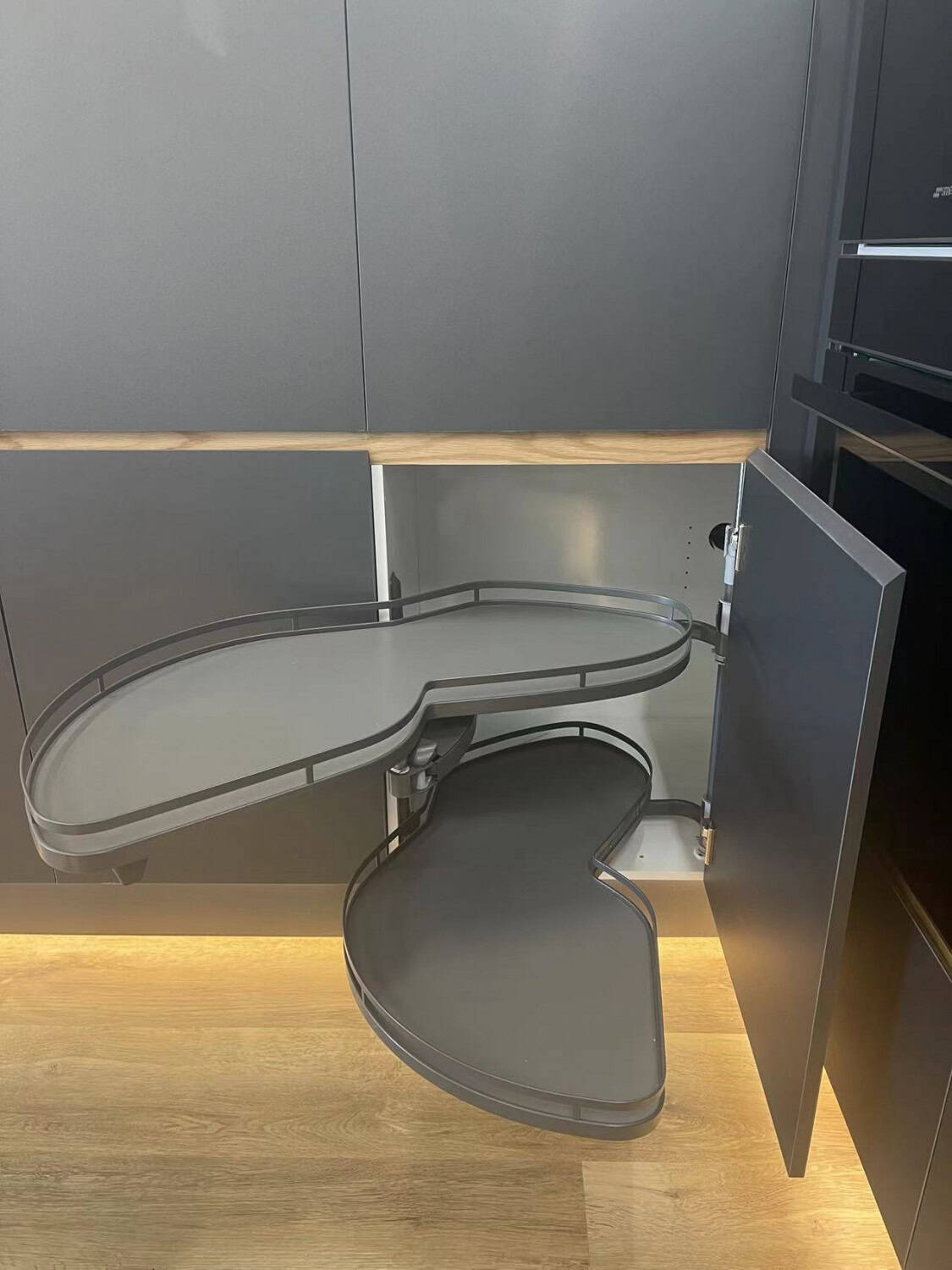
Magic-corner pull-out
4. Clean-Lined Cooktop
If counter space is tight, a flat glass ceramic cooktop keeps the bench reading as one continuous surface. It suits any kitchen style and doesn’t break up the line of the bench the way a raised cooktop can.
5. Sort the Spices
A functional kitchen is won in the details. A dedicated spice drawer with small containers — rather than a cupboard where everything migrates to the back — is the kind of small organisational win you notice every time you cook.
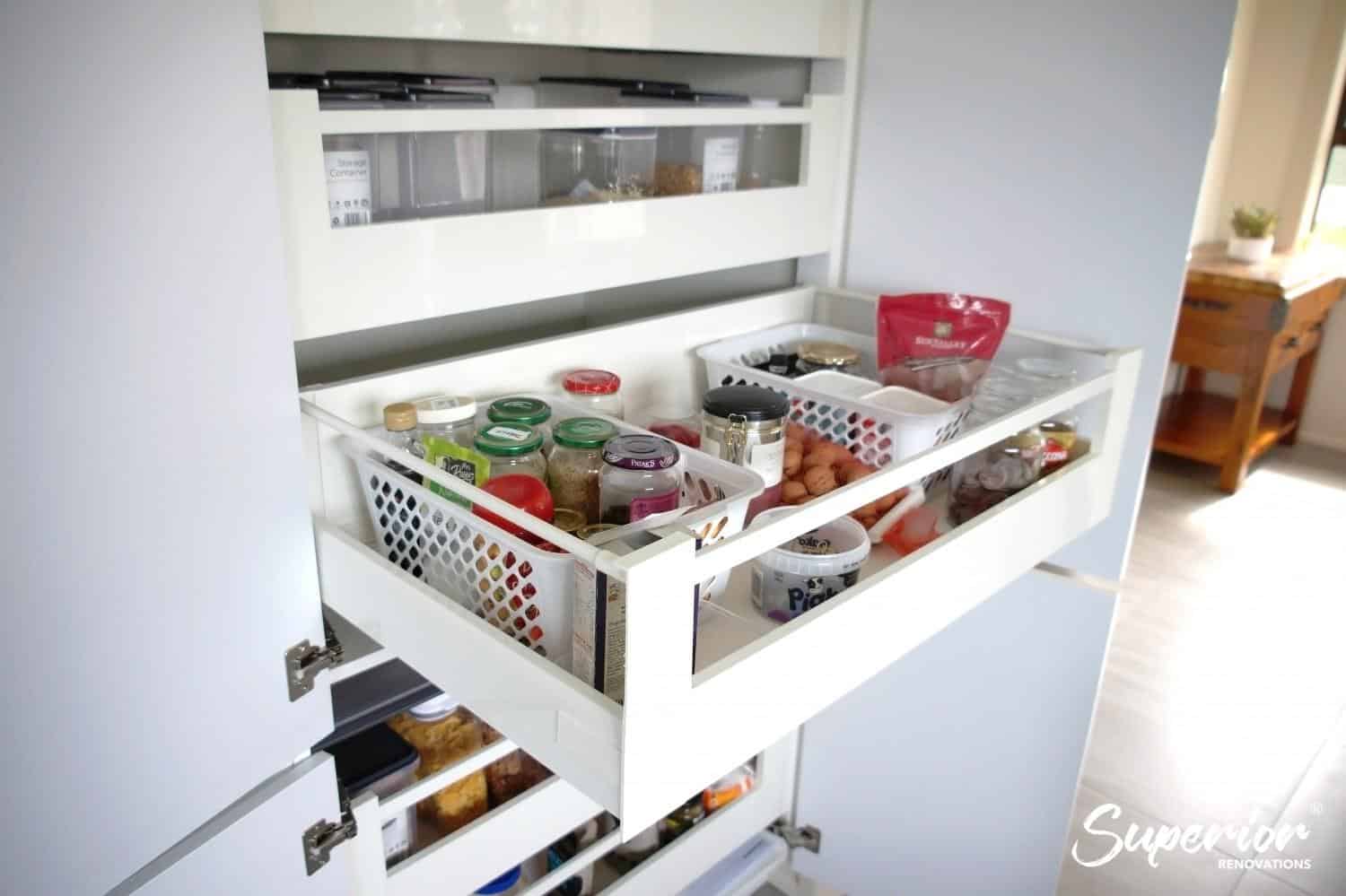
Pantry with pull-out drawers
6. Keep Continuity
You don’t need a big budget for a resolved look. Integrated appliance doors that match your cabinetry give a unified, finished kitchen without the cost of a full custom fit-out — the eye reads one clean run instead of a row of different appliance fronts.
7. Light the Dark Spots
Nobody enjoys hunting through a dark drawer. Plug-in LED strips with motion sensors inside drawers and cabinets are cheap and genuinely useful, and good task lighting over the bench is non-negotiable in a working kitchen.

Lighting on the splashback
The 6 Most Popular Kitchen Layouts — Which Suits Your Space?
Now the dimensions are sorted, here are the six layouts in detail. The right one comes down to your room’s shape and how your household actually uses the kitchen.
1. U-Shaped Kitchen
U-shaped kitchens run cabinetry along three walls, forming a U. They give you ample room to cook, store and entertain, and a larger U can take an island in the middle for extra bench space. You’ll usually find them in a standalone room or the corner of a large open space. The modern version has evolved — an L-shaped run plus a disconnected island that completes the U — which fits the open-plan living most Auckland homeowners want now.
Project specs + photos — Guru and Neeta’s modern U-shaped kitchen
Got a small kitchen but love the U? Go for the modern take — an L-shaped run with a narrow island that doubles as a breakfast bar.
Project specs + photos — Amber and Craig’s U-shaped kitchen in Hillsborough
5 Ideas for a U-Shaped Kitchen
Central dining table: if there’s room, an island adds storage and a gathering point — but in a genuinely large kitchen, a dining table can be more comfortable than crowding around an island.
Add depth with paint: a U-shape can read boxy. A single dark feature wall, or dark paint on the base of an island, creates a focal point and adds depth.
Pendant lighting: a large kitchen needs to be well lit. Pendants over the middle of the room or a dining area define the space and make it more welcoming.
Open shelving: swapping some upper cabinets for floating shelves opens the room up. Style them simply and keep them tidy.
An entertaining space: if you host, leave room to talk with guests while you cook — the kitchen has always been where everyone ends up anyway.
2. L-Shaped Kitchen
An L-shaped kitchen suits smaller spaces — apartments, units, kitchens for couples or singles. It has one less wall of cabinetry than a U, so less storage and bench, but it’s a cleaner fit for a compact room. Build storage vertically to make up the difference. It’s also the layout of choice for an unused corner, and in an open-plan living/dining space you can add a small island that doubles as a dining spot, freeing you from a separate table you never use.
Project specs + photos — L-shaped kitchen with large island, Blockhouse Bay
5 Ideas to Maximise an L-Shaped Kitchen
Link with materials: matching the surface, cabinetry colour and hardware across both runs gives a cohesive look and makes the room feel larger.
Balance your storage: paint upper cabinets the same colour as the walls so they recede, and go a touch lighter on the lowers. You keep the storage without the bulk.
Create a practical workspace: keep the work triangle tight so everything flows.
Balance the L with a window: position one run under a window where you can — it balances the layout and floods the room with light.
Store vertically: floor-to-ceiling cabinetry on one wall uses the full height, and a magnetic rail keeps knives off the bench.
3. Galley Kitchen
Galley kitchens run two parallel walls with a walkway between, often in a room of their own. They’re common in older Auckland homes, and increasingly people knock out one wall to fold the galley into an open-plan living space. If you’re removing a wall with cabinetry against it, turn that run into a long island so you keep the storage and bench. Another option is a large open servery window in the wall instead of demolishing it entirely. If you’re weighing up opening the room right up, our open plan kitchen guide covers what’s involved.
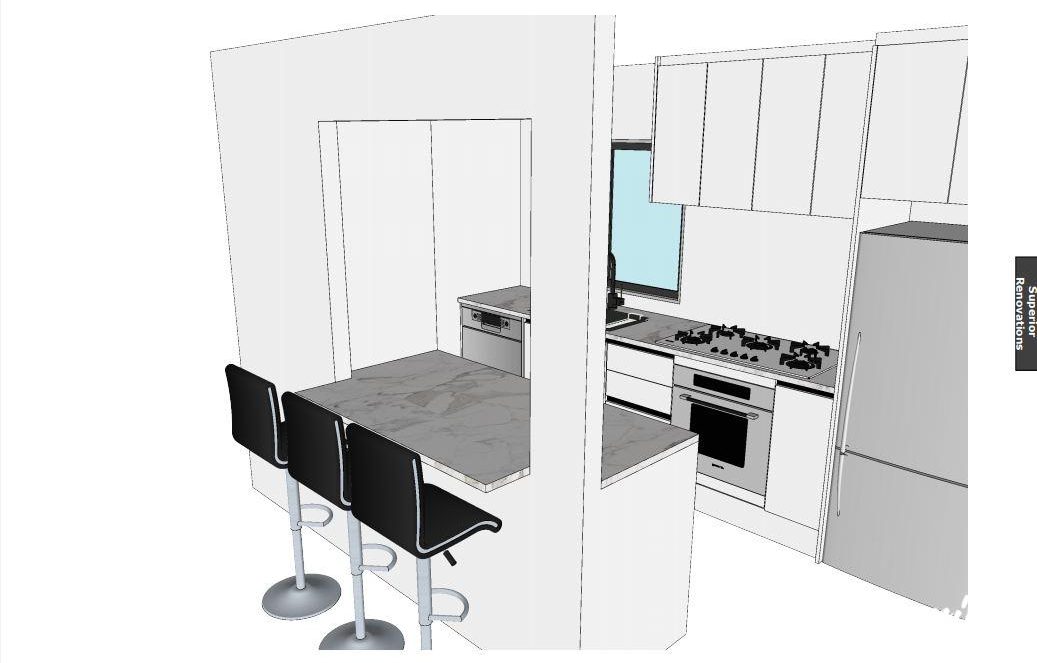
This client wanted her galley kitchen folded into the living space but kept the storage — so we added a servery window and extended the counter into an island for casual dining.
Photos and project specs — Open-style galley kitchen in Epsom
5 Galley Kitchen Ideas
Add lighting: natural light is ideal, but where you can’t get it, worktop spots and well-placed pendants do the job. Shiny tile, metal and glass bounce light and make the room feel bigger.
Keep it simple: handle-free doors, a monochromatic light-neutral palette, and one statement piece — a rug or a high-end tap — keep a galley feeling airy.
Open it up: the easiest way to add function is an island for prep, storage and casual seating.
Hanging storage: rails for pots and pans, or floating shelves, free up cabinet and counter space.
Clear the bench: a microwave drawer and tall storage keep the countertops clear, which makes a narrow galley feel calmer.
4. Island Kitchen
Islands have come and gone over the decades. Today’s island isn’t just a prep bench — it’s storage on every side, extra surface, and a casual breakfast spot. It won’t fit every room, but there are sleeker, smaller versions now, and you can add one to an L, U or galley as long as there’s clearance to move around it. For more design direction on islands and finishes, see our kitchen ideas guide.
5 Island Kitchen Ideas
Squeeze in a moveable island: tight on space? A portable island gives you extra surface and seating you can roll out of the way.
A splash of colour: in a neutral kitchen, painting the island a contrast colour is a quick lift without a full renovation.
Extra storage at one end: shelves on the end of the island beat blank panels — a 10cm-deep gap makes a handy spot for oils and condiments.
Position appliances away from the entertaining side: face the cooking onto the social area but keep the working appliances on the inside of the island.
Light it well: the island becomes the focal point and a prep zone, so it needs proper lighting overhead.
5. Peninsula Kitchen
A peninsula is an island connected at one end. It gives you the extra bench or dining area an island would, in a room that can’t take a standalone one. It works especially well with an L-shaped kitchen. Lynette’s family wanted a breakfast nook but didn’t have room for a central island — so we built a peninsula that gave them the nook without crowding the space.

A custom peninsula in this Bucklands Beach renovation added bench space and a breakfast nook.
Project specs for the kitchen above
3 Peninsula Kitchen Ideas
Banquette seating on the back: if there’s room, built-in banquette seating fits more people around the table and turns the peninsula into a social spot.
Open shelving: open shelves keep everyday gear within reach and let more light into the room.
Light fixtures: pendants over the peninsula brighten the workspace and add visual appeal.
6. Two-Island Kitchen
Only an option in a genuinely large kitchen — two islands in the middle with a walkway between. Use one for prep and put a cooktop in the other to make it your cooking zone. Two smaller islands beat one enormous one: more accessible, easier to walk around, better flow overall.
Featured Kitchen Renovation Projects
Urban Luxury Kitchen, Parnell — Open-Plan U-Shaped
This Parnell townhouse had a tiny kitchen with no counter space. We changed the whole layout, moving the kitchen from the left of the room to the right, then added cabinetry in the dining area as extended storage — shelves with internal lights that open when needed. See the before and afters.
 |
 |
 |
Entertainer’s Dream, Massey — Modern U-Shaped Open-Plan
Guru and Neeta had a closed-off kitchen that shut them out of open-plan living. They wanted luxury and an entertaining space. We opened it up and extended the counter toward the lounge to work as a bar. See more.
 |
 |
 |
Cottage Kitchen, Mangere Bridge — Peninsula
This one was about natural elements that reflected the client’s country surroundings. A dated kitchen became a chic country-style space — treated real-wood benchtops, a butler’s sink, floating shelves, and cabinetry wrapped in Dezignatek Thermoform with a ‘Ronda’ pattern for a vintage look. See more.
 |
 |
 |
Open-Plan Galley, Epsom
We renovated this historic Epsom bungalow for a young family — durable, easy-clean materials and an open-style galley that lets everyone share one space. See the full project.
 |
 |
 |
Ready to Plan Your Kitchen Layout?
The layout is the foundation of the whole renovation — worth getting right before a single cabinet is ordered. If you’d like our designers to work through your space, your work triangle and the right layout for how your household cooks, we’d love to help.
➡ Book your free in-home consultation with Superior Renovations
➡ Use our kitchen renovation cost calculator to estimate your project
➡ Request a free feasibility report for your project
Kitchen Layout FAQ
What is the best kitchen layout?
There's no single best kitchen layout — it depends on your room and how you cook. The key is the work triangle: keep your sink, stove and fridge close enough to move between in a few steps, with no through-traffic crossing the middle. For tighter Auckland spaces an L-shaped or galley layout works best; where there's more room, a U-shaped or island layout gives more bench and storage. Plan the layout around your work triangle first, then choose the shape that fits your space.
What is the kitchen work triangle?
The work triangle is the path between the three busiest points in a kitchen — the sink, the stove and the fridge. The three legs should total roughly 4 to 8 metres, and nothing (no island, table or main walkway) should cut through the middle. It's the oldest kitchen-planning rule and still the most useful. In modern open-plan kitchens it's often paired with zoning — separate prep, cooking, cleaning and storage areas — to handle more than one cook at once.
Which kitchen layout is best for a small kitchen?
For a small Auckland kitchen — an apartment, a unit, or a tight villa space — a galley or L-shaped layout usually works best. A galley uses two parallel walls efficiently for one main cook; an L-shape frees up a corner and pairs well with a small island or peninsula that doubles as dining. Single-wall layouts suit the very smallest footprints. In all of them, build storage vertically with tall cabinetry and wall storage to make up for the smaller footprint.
What are the standard kitchen measurements?
Standard bench height is 900mm with a 600mm depth. Allow at least 120cm of clearance in front of appliances for loading, and 100 to 120cm around an island for traffic. Bar-stool seating needs a 30 to 45cm bench overhang, and a kitchen used by two cooks wants 90 to 120cm walkways so people can pass. Getting these few numbers right is usually the difference between a kitchen that flows and one that feels cramped.
How many kitchen layouts are there?
There are six main kitchen layouts: galley (two parallel runs), L-shaped (two adjoining walls), U-shaped (three walls), island (a freestanding central bench), peninsula (an island connected at one end), and single-wall (everything on one wall). Most Auckland kitchens are a version of one of these, often combined — for example an L-shaped run with an island, which is the modern take on the U-shaped kitchen.
Should I put my cooktop on the island?
You can, but we usually advise against it. A cooktop on an island needs an expensive extraction system to handle steam and smoke, and you lose the splashback that catches splatters — which matters in humid Auckland kitchens where poor ventilation leads to mould. Putting the cooktop on an exterior wall makes ventilation simpler to run and gives you a splashback for free. If you do want it on the island, budget properly for the extraction.
How much space do you need around a kitchen island?
Allow 100 to 120cm of clearance on all sides of a kitchen island. Less than that and only one person can work comfortably, and the island's own cabinet doors start colliding with the run behind them. More than 120cm and you're walking too far between zones. If your room can't give you at least a metre around a standalone island, a peninsula — connected at one end — is usually the better call.
Do you provide a kitchen designer and 3D plans?
Yes. We have in-house kitchen designers who develop your layout and provide 3D drawings as part of the proposal, so you can see the kitchen before anything is manufactured or installed. We provide a full renovation service — design, demolition, sourcing materials from local supplier showrooms, custom cabinetry, installation, project management, and all trades including electricians, plumbers, tilers, builders and grouters. You don't need to arrange your own tradespeople.
What's the most popular kitchen layout in NZ?
The L-shaped kitchen is the most versatile and widely used in New Zealand homes, because it suits small-to-medium spaces and adapts easily to open-plan living when paired with an island. In larger Auckland homes the U-shape and island layouts are popular for the bench space and storage they offer. The strongest current trend is an L-shaped run plus a disconnected island — a modern version of the U-shape that fits the open-plan living most homeowners now want.
Further Resources for your kitchen renovation
- Featured projects and Client stories to see specifications on some of the projects.
- Real client stories from Auckland.
Need more information?
Take advantage of our FREE Complete Home Renovation Guide (48 pages), whether you’re already renovating or in the process of deciding to renovate, it’s not an easy process, this guide which includes a free 100+ point check list – will help you avoid costly mistakes.
Download Free Renovation Guide (PDF)

Have you been putting off getting renovations done?
We have partnered with Q Mastercard ® to provide you an 18 Month Interest-Free Payment Option, you can enjoy your new home now and stress less.
Learn More about Interest-Free Payment Options*
*Lending criteria, fees, terms and conditions apply. Mastercard is a registered trademark and the circles design is a trademark of Mastercard International Incorporated.
Still have questions unanswered?
Book a no-obligation consultation with the team at Superior Renovations, we’d love to meet you to discuss your renovation ideas!
[contact-form-7]
The post Kitchen Layout Guide NZ: 6 Layouts & the Work Triangle appeared first on Superior Renovations. #superiorrenovations


Comments
Post a Comment