Underfloor Heating NZ: Cost, Running Costs & Worth It?
Originally posted on Underfloor Heating NZ: Cost, Running Costs & Worth It?
Superior Renovations - Auckland’s Trusted Home Renovation Specialists
Underfloor Heating NZ: What It Costs, What It Costs to Run, and When It’s Worth It
Quick answer: Underfloor heating in NZ costs roughly $80–$150/m² installed for electric and $150–$200/m² for hydronic, and running an electric system in a 9m² bathroom works out around $12–$18 a month at 35c/kWh. It’s worth it when the floor is already coming up — far less so as a standalone retrofit.
Most people who ask us about underfloor heating have stood on a cold tiled floor in a Mt Eden bungalow at 6am in July and thought, never again. That’s the right instinct. The wrong move is deciding it’s worth it — or not worth it — before anyone’s told you what it actually costs to run, or whether your floor can even take it without a major dig-up.
We’re a renovation company, not a heating supplier. So this is the version we give clients across the table at our Wairau Valley showroom: what underfloor heating costs to put in, what it costs to run on real Auckland power prices, where it earns its keep, and where a $400 towel rail does the same job for a tenth of the money.
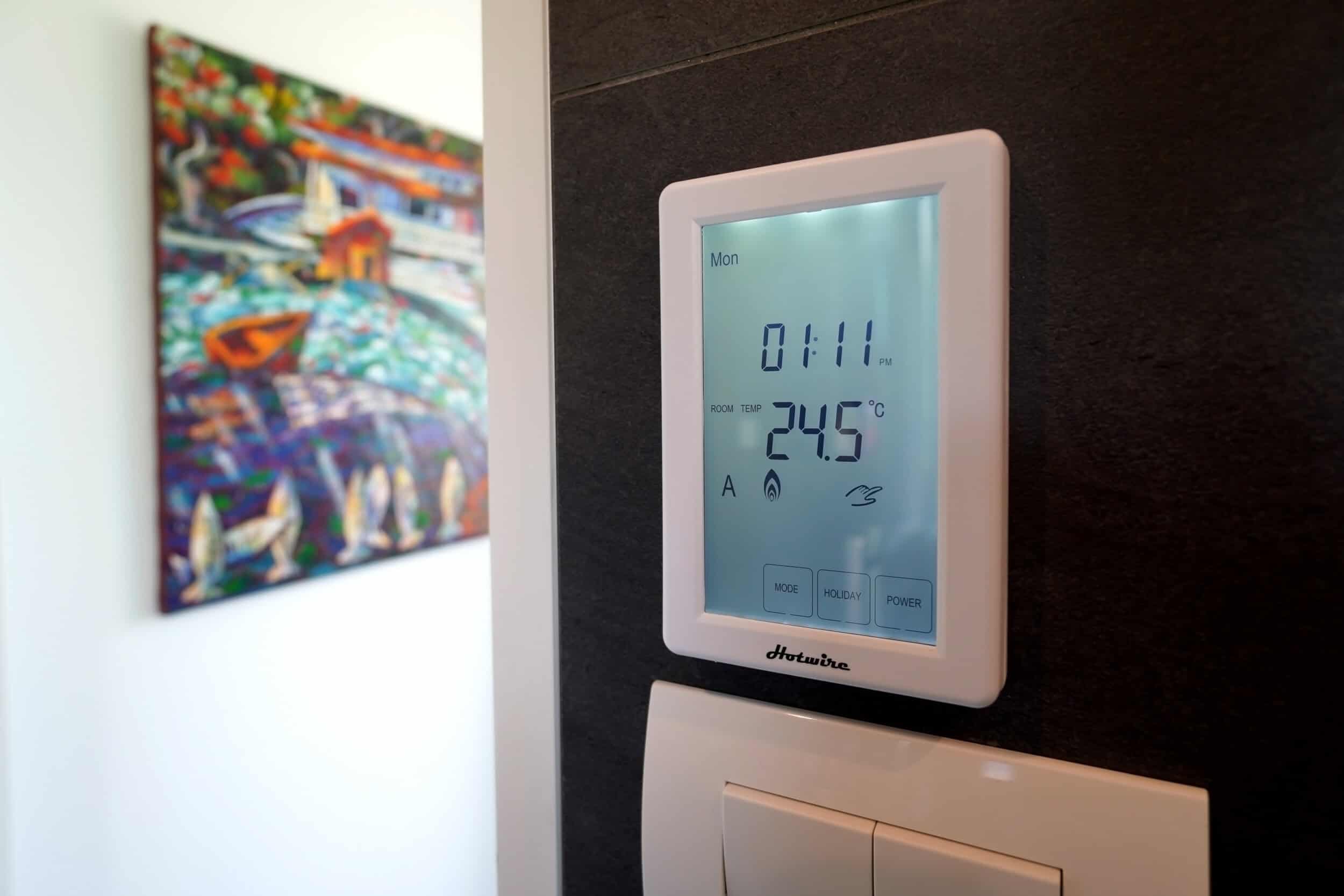
Underfloor heating panel – Hotwire
Electric vs Hydronic Underfloor Heating: Which One Suits a Renovation?
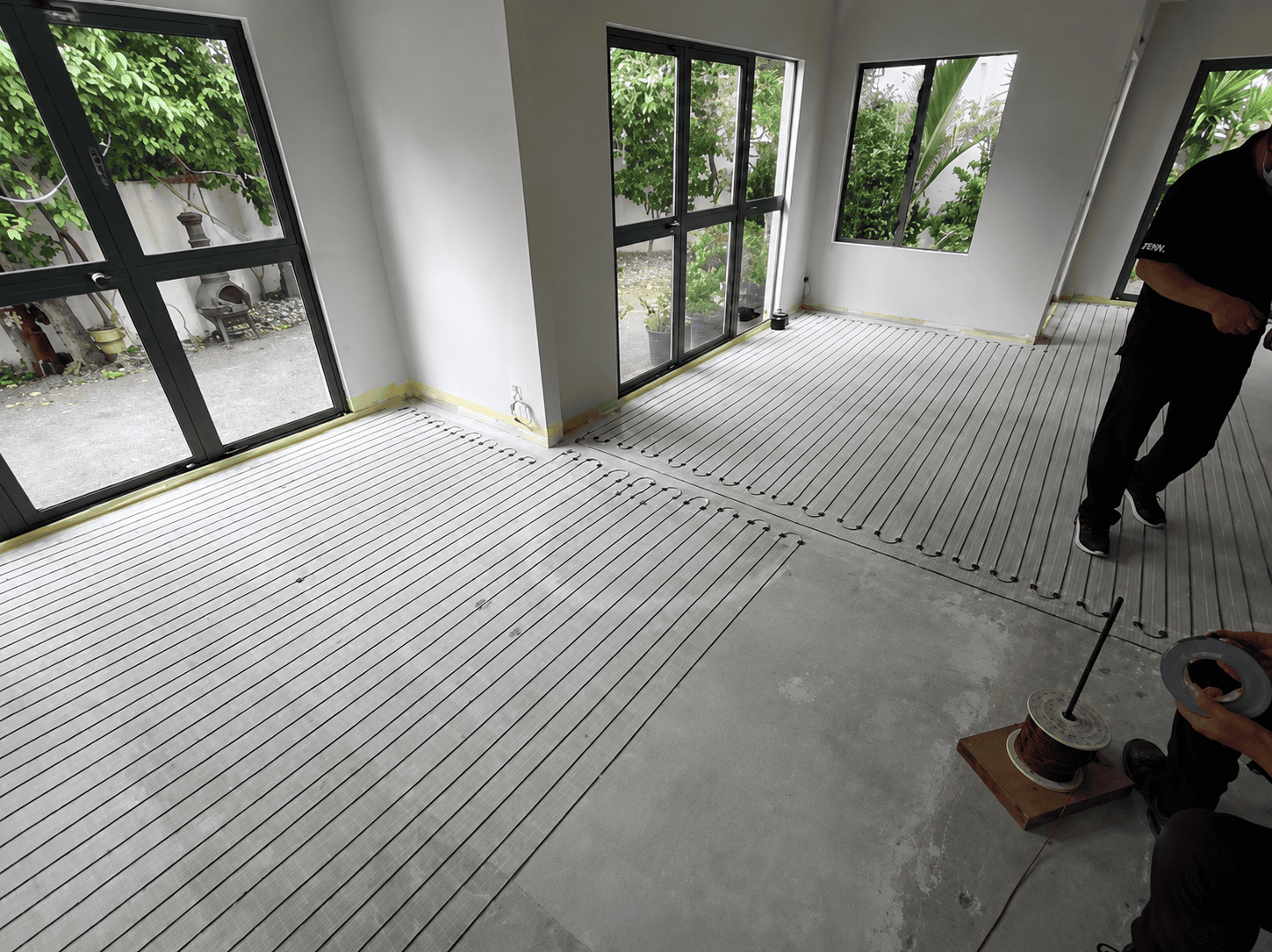
There are two systems, and the gap between them matters more for renovators than for new builds. Electric (sometimes called “wire” or “dry” systems) is a thin heating mat or cable that sits under your floor finish. Hydronic (“wet” systems) runs warm water through pipes laid in or under the floor.
For a renovation, electric wins most of the time. The mat is only a few millimetres thick, so it barely changes your floor height — which is the thing that quietly kills retrofits. Warmup NZ, the brand most Kiwis associate with the category, makes the same point: electric suits upgrades to existing homes, hydronic suits new slabs.
When Hydronic Actually Makes Sense
Hydronic comes into its own on a concrete slab in a new build or a full ground-floor extension — heating a large area, every day, for years. The pipes and manifold cost more upfront, but the running cost per square metre is lower, so over a whole house it pays back. Pump it through a small bathroom retrofit and the maths falls over: too much plumbing, too much disruption, for one cold room.
Here’s the short version we give people. Doing one or two rooms in an existing home? Electric. Building new or extending with a fresh slab and heating the whole floor plate? Get hydronic priced.
“The number that decides it on a reno is floor height, not the heating spec. Once you’ve got tiles, underlay and a mat to stack up against an existing doorway and the hallway floor next door, a couple of millimetres is the difference between a clean job and re-hanging every door. We work that out before we ever talk brands.”
— Cici Zou, Certified Designer (NZ Dip. Interior Design), Superior Renovations
💡 Quick tip: If you’re tiling a bathroom or kitchen anyway, that’s the cheapest moment you’ll ever get to add electric underfloor heating — the floor’s open, the tiler’s there, and the only real extra is the mat and a thermostat.
The system we spec on bathroom and tiled-area jobs is Heatwell electric — it’s reliable, easy to integrate while the floor’s up, and the running costs stack up sensibly for the room sizes most Auckland homes have. We recommend by the room, not by the brochure.
How Much Does Underfloor Heating Cost to Install in NZ?
Install cost depends on the system, the area, and what’s already under your floor. Here are the ranges we work with on Auckland renovations — and where the published supplier figures sit, so you can sanity-check any quote you’re handed.
| System | Install cost (per m²) | Typical bathroom (8–10m²) | Best for |
|---|---|---|---|
| Electric mat/cable | $80–$150 | $1,500–$4,000 | Retrofits, bathrooms, single rooms, tiled areas |
| Hydronic (water) | $150–$200+ | Rarely cost-effective at this size | New builds, slabs, whole-home, large open-plan |
| Whole-home hydronic (new build) | — | $17,000–$40,000+ (full system) | Designed in from the slab up |
Those per-m² figures line up with what NZ suppliers publish — installed electric figures from $60–$100/m² for straightforward jobs, climbing once you factor in a separate circuit, thermostat, and any floor prep. For a standard Auckland bathroom, budget $1,500–$4,000 for electric underfloor heating supplied and installed — and remember that’s a line item inside a wider $26,000–$35,000 mid-range bathroom renovation, not a standalone bill.
The Hidden Cost Nobody Quotes For: Floor Prep
The mat is cheap. Getting your floor ready for it sometimes isn’t. On a 1970s brick-and-tile in Manurewa with a timber subfloor, you may need a self-levelling compound or a backer board before anything goes down — that’s labour and material the headline per-m² rate doesn’t include. On a concrete slab it’s usually simpler. This is exactly why a real quote beats a calculator estimate, and why we’d rather see your floor than guess.
Want a sense of where heating sits inside your total bathroom budget before we visit? Run the numbers on our bathroom renovation cost calculator — it’ll give you a realistic range to work from.
💡 Quick tip: Always get the heating wired on its own thermostat with a timer. It’s a small line item at quote stage and it’s the single biggest lever on what the thing costs you to run later.
Underfloor Heating Running Costs in NZ — The Number Most Guides Dodge
This is where most underfloor heating content goes vague, because the honest answer takes a bit of maths. So let’s do it properly, on Auckland power prices.
Electric underfloor heating draws roughly 150 watts per square metre. Take a typical 9m² Auckland bathroom — that’s about 1,350 watts, or 1.35 kilowatts, at full draw. At 35c per kWh (a fair current Auckland retail rate), running it flat-out costs around 47 cents an hour.
But you don’t run it flat-out. With a thermostat and timer set for an hour or two morning and evening through winter, you’re realistically looking at around $12–$18 a month across the colder months for that bathroom — and close to nothing the rest of the year. That’s the same ballpark as a heated towel rail left on, and far less than most people assume when they hear “electric heating.”
Scale that up and the picture changes. Heat a whole open-plan living floor with electric and the monthly bill climbs fast — which is precisely why hydronic, with its lower cost per square metre, takes over for large areas. EECA makes the broader point that how you control heating matters as much as the system itself: a timer and thermostat are doing most of the work on your running cost, whatever the brand on the box.
| Area | Approx. draw | Cost per hour at 35c/kWh | Realistic winter month (timed use) |
|---|---|---|---|
| 9m² bathroom | ~1.35 kW | ~47c | ~$12–$18 |
| 15m² kitchen/diner | ~2.25 kW | ~79c | ~$25–$40 |
| 40m² open-plan (electric) | ~6 kW | ~$2.10 | Hydronic territory — price it instead |
The figures are indicative — your wattage, insulation, and how long you run it all move the dial. But the shape is right, and it’s a lot more useful than “it depends.”
💡 Quick tip: Good underfloor heating relies on a warm, dry slab or floor holding heat. If your subfloor’s poorly insulated, you’re paying to heat the dirt below. Pairing underfloor heating with proper floor insulation is what makes the running cost behave.
Best Applications: Bathrooms, Tiles, and the Slab-vs-Timber Question
Underfloor heating shines under hard floors. Tile, stone, polished concrete — they conduct heat well and they stay warm. That’s why bathrooms are the number-one spot we install it: cold tile underfoot is the exact problem it solves, and the room’s small enough that running cost stays sensible.
Kitchens with tiled or stone floors are the next best fit. Engineered stone and quartz benchtops aside, a tiled kitchen floor over electric heating is a genuinely nice thing to stand on while you cook on a winter morning in Titirangi.
Concrete Slab vs Timber Subfloor
This is the make-or-break question for retrofits. A concrete slab is the ideal host — it stores heat and releases it slowly, so the system works efficiently. A suspended timber subfloor, common in older Auckland villas and bungalows, is trickier: there’s an air gap below, heat can escape downward without insulation, and the floor build-up has to be managed carefully. It’s still doable with electric mats over a properly prepped and insulated timber floor — we do it regularly — but it needs planning, not a punt.
What Flooring Works (and What Doesn’t)
Tile and stone are ideal. Many engineered timber and quality vinyl products are rated for underfloor heating too — but not all, and laying an unrated floating floor over heating can void its warranty or warp the boards. Always check the flooring’s underfloor-heating rating before you commit, not after. Solid hardwood is generally the wrong choice; it moves too much with the temperature swings. The Wooden Floor Company and other NZ suppliers note that engineered timber handles the temperature changes better than solid timber — which matches what we see on site.
If you’re choosing tiles and heating together, our bathroom renovation team sorts both as one decision — the floor finish, the heating, the waterproofing and the levels all get worked out before the tiler starts, which is the whole point of doing it inside a renovation.

Underfloor Heating vs Heated Towel Rail vs Panel Heater
Here’s the honest comparison — because for a lot of bathrooms, underfloor heating isn’t the right answer, and we’ll tell you that.
| Option | Install cost | Heats the room? | Best when |
|---|---|---|---|
| Electric underfloor | $1,500–$4,000 | Yes — warm floor + radiant warmth | You’re retiling anyway and want the floor experience |
| Heated towel rail | $300–$700 | Partly — dries towels, takes the edge off | Budget’s tight or the floor’s staying put |
| Panel / wall heater | $300–$1,050 | Yes — fast air heat | You want quick warmth, not warm floors |
The truth most people don’t hear: if the floor isn’t already coming up, the cost of retrofitting underfloor heating alone rarely justifies it over a good towel rail plus a ceiling unit. Where it’s a no-brainer is when you’re already renovating — then the marginal cost is small and the payoff is daily.
We go deeper on rails, ceiling units and wall heaters in our companion guide to choosing the right bathroom heater for NZ conditions — worth a read if you’re weighing underfloor against the simpler options.
Can You Retrofit Underfloor Heating in an Existing Auckland Home?
Yes — with one honest caveat. Retrofitting only makes sense when you’re already lifting the floor. Tearing up a perfectly good bathroom purely to add heating is money poorly spent. Doing it as part of a renovation, when the tiles are coming off anyway, is one of the best-value upgrades on the job.
The practical hurdles in an older home are floor height and the subfloor type. Add a heating mat, backer board and new tiles, and your finished floor sits higher than it did — which affects door clearances and the transition to the hallway. On a villa in Grey Lynn with a timber subfloor, that needs designing around. On a slab-on-ground 1990s home in Albany, it’s usually straightforward. None of it is exotic; it just needs to be planned at design stage, not discovered mid-build.
For whole-home or extension projects where heating is part of a bigger thermal upgrade, it’s worth thinking about the envelope as a whole — insulation, glazing and heating together. If you’re combining heating with a larger structural change, our house extensions team can build it into the plan from the start.
“The clients who love their underfloor heating are the ones who added it during a reno they were doing anyway. The ones with regrets usually retrofitted a single room in isolation and paid for the disruption without the rest of the upgrade around it. Timing is most of the value.”
— Cici Zou, Certified Designer (NZ Dip. Interior Design), Superior Renovations
Does Underfloor Heating Help with Healthy Homes and Damp?
Worth being straight here, because it’s oversold elsewhere. Underfloor heating is comfortable and it warms a room evenly, which helps keep surfaces above the dew point and discourages the mould that plagues Auckland bathrooms through our 70–80% winter humidity. That’s a real benefit.
But it’s not a Healthy Homes compliance product. The Healthy Homes Standards are about rental properties and centre on a fixed heating device in the main living room, plus ventilation, insulation, draught-stopping and moisture management — not underfloor heating specifically. If you’re a landlord, don’t install underfloor heating expecting it to tick the heating standard; check the actual requirements first. If you’re an owner-occupier chasing a warmer, drier home, it’s a genuine comfort upgrade — just paired with good ventilation and insulation, not instead of them.
Important note: Hardwired underfloor heating must be installed by a licensed electrician and comply with the NZ Building Code. It’s not a DIY job — and if you’re already having electrical work done in a renovation, bundling it in is the cheapest, cleanest way to get it done right.
So, Is Underfloor Heating Worth It in NZ?
If you’re renovating and the floor’s coming up, electric underfloor heating in a bathroom or tiled area is one of the easiest yeses we give. Small marginal cost, daily payoff, sensible running cost. If you’re thinking about ripping up a sound floor purely to add it, the honest answer is usually no — put the money toward a great towel rail and ventilation instead.
The decision really comes down to timing and floor type, and both are easiest to sort with someone looking at your actual home rather than a spec sheet. That’s what we do — across 1000+ Auckland renovations, heating gets decided alongside tiling, levels and waterproofing, not bolted on at the end.
➡ Book your free in-home consultation with Superior Renovations
➡ Estimate your bathroom renovation cost with our calculator
➡ Request a free feasibility report for your project
Is underfloor heating worth it in NZ?
It's worth it when you're already renovating and the floor is coming up — the marginal cost of electric underfloor heating in a bathroom or tiled area is small and the daily comfort payoff is high. As a standalone retrofit, where you'd tear up a sound floor just to add it, it's usually not worth it over a good heated towel rail plus a ceiling unit. The deciding factors are timing and floor type, not the heating brand.
How much does underfloor heating cost in NZ?
Electric underfloor heating runs about $80–$150/m² installed, which works out to roughly $1,500–$4,000 for a typical 8–10m² Auckland bathroom supplied and fitted. Hydronic (water) systems cost more at around $150–$200+/m² and make sense for new builds and whole-home slabs rather than single-room retrofits. Floor preparation, a dedicated circuit and a thermostat can add to the headline per-m² rate, which is why an on-site quote beats an online estimate.
Is underfloor heating expensive to run in NZ?
Not for a bathroom. Electric underfloor heating draws around 150 watts per m², so a 9m² bathroom pulls about 1.35kW — roughly 47 cents an hour at 35c/kWh. Run on a timer and thermostat for an hour or two morning and evening through winter, that's around $12–$18 a month and close to nothing the rest of the year. Costs climb fast over large areas, which is where hydronic takes over.
What's the difference between electric and hydronic underfloor heating?
Electric systems use a thin heating mat or cable under the floor finish — only a few millimetres thick, so they suit retrofits and single rooms. Hydronic systems run warm water through pipes laid in or under the floor; they cost more upfront but run cheaper per m², so they suit new builds, slabs and whole-home heating. For renovating one or two rooms in an existing Auckland home, electric is almost always the right call.
Can you retrofit underfloor heating in an existing house?
Yes, with electric mats — but it only makes financial sense when you're already lifting the floor as part of a renovation. The two practical hurdles are floor height (the mat, backer board and new tiles raise the finished floor, affecting door clearances) and subfloor type. A concrete slab is the ideal host; a suspended timber subfloor, common in older Auckland villas and bungalows, needs careful insulation and planning but is still doable.
What flooring works with underfloor heating?
Tile, stone and polished concrete are ideal — they conduct and hold heat well. Many engineered timber and quality vinyl products are rated for underfloor heating, but not all, so check the manufacturer's rating before laying anything over a heating system, as an unrated floating floor can warp or void its warranty. Solid hardwood is generally a poor choice because it moves too much with the temperature swings.
Is underfloor heating good for bathrooms in Auckland?
It's the single best application. Bathrooms are small, so running cost stays low, and cold tile underfoot is exactly the problem underfloor heating solves. Auckland's winter humidity of 70–80% makes warm, even heat useful for keeping surfaces dry and discouraging mould on fresh tiles. We install electric underfloor heating most often in bathrooms and tiled ensuites, specced in alongside the waterproofing and tiling rather than added afterwards.
Does underfloor heating meet Healthy Homes Standards?
Not on its own. The Healthy Homes Standards apply to rental properties and require a fixed heating device in the main living room, plus standards for ventilation, insulation, draught-stopping and moisture. Underfloor heating isn't a recognised compliance product for the heating standard, so landlords shouldn't install it expecting it to tick that box. For owner-occupiers it's a genuine comfort and dryness upgrade, best paired with good ventilation and insulation rather than used instead of them.
Underfloor heating or a heated towel rail — which should I get?
If you're retiling the bathroom anyway, underfloor heating ($1,500–$4,000) gives you a warm floor and radiant warmth across the whole room. If the floor's staying put or the budget's tight, a heated towel rail ($300–$700) dries towels and takes the chill off at a fraction of the cost. Many Auckland bathrooms do well with a towel rail plus a 3-in-1 ceiling unit, with underfloor reserved for when the floor is already open.
Do I need building consent for underfloor heating?
The heating mat itself usually doesn't, but the electrical work must be done by a licensed electrician and comply with the NZ Building Code, and any wider bathroom renovation it's part of may trigger consent for plumbing or waterproofing changes. The simplest path is to install underfloor heating as part of a managed renovation where the consents and the licensed trades are already handled — which removes the guesswork for you.
Further Resources for your bathroom renovation
- Featured projects and Client stories to see specifications on some of the projects.
- Real client stories from Auckland
Need more information?
Take advantage of our FREE Complete Home Renovation Guide (48 pages), whether you’re already renovating or in the process of deciding to renovate, it’s not an easy process, this guide which includes a free 100+ point check list – will help you avoid costly mistakes.
Download Free Renovation Guide (PDF)
Have you been putting off getting renovations done?
We have partnered with Q Mastercard ® to provide you an 18 Month Interest-Free Payment Option, you can enjoy your new home now and stress less.
Learn More about Interest-Free Payment Options*
*Lending criteria, fees, terms and conditions apply. Mastercard is a registered trademark and the circles design is a trademark of Mastercard International Incorporated.
Still have questions unanswered?
Book a no-obligation consultation with the team at Superior Renovations, we’d love to meet you to discuss your renovation ideas!
[contact-form-7]
The post Underfloor Heating NZ: Cost, Running Costs & Worth It? appeared first on Superior Renovations. #superiorrenovations


Comments
Post a Comment